

Book Reviews: Stoppee, Odell and Deunkel
To survive in this business climate, to improve our art, to differentiate our work — whatever our goal, we must continue to learn and grow as photographers.
Fortunately, there has never been a greater variety of learning tools available. We have the electronic — online courses, webinars, DVD’s, and the tried and true, the “old technology” — books.
When I find something great, something from which I’ve learned a lot, I put it on a list for review in a newsletter or on this site. Unfortunately, because I am so anal and so focused on details, I have not been able to write a short review. Everything becomes an opus. I can’t write a quick opus; so I write nothing at all. And, really good learning tools, things I should be bringing to your attention, go in a stack of “future topics” whose day on these pages never seems to arrive.
The solution? Some shorter reviews. When I started this site, I deliberately created the “Quick Focus” column as a way of getting information out quickly if not definitively. Along the way, I lost sight of the mission. Today, I get back on track by putting a Quick Focus on some really great books — books from which I’ve learned a lot, books that deserve a broad audience.
Stoppees’ Guide to Photography and Light: What Digital Photogrpahers, Illustrators, and Creative Professionals Must Know [Brian and Janet Stoppee, Focal Press (2009)]
 This is the reference book I wish I would have had when I entered the world of digital photography.
I’d call it an “encyclopedia” of all things related to light and photography but that would make it seem boring. For all it’s depth of coverage, it is a beautifully illustrated, clearly written, one-stop-answer shop. I actually enjoy reading it. Rather than simply using it as a source to answer specific questions, I’ve taken to reading random chapters just for the fun of it.
More than anything, this book is practical and straight to the point. I’ve always believed that the one quality that defines good teachers is their ability to make the complicated simple. Far too many writers try to impress us by staying at a level of technicality that is intended to show us how much they know as opposed to sharing that knowledge with us in ways that even we can understand it. The Stoppees meet my definition of teachers. They make all of the information understandable and useable.
I’ll never forget how confused I was when one of my early photography teachers started talking about the physics principles surrounding the “Angles of Incidence and Reflection”. I had no idea what he was talking about, why it mattered, or how it related to my work. The Stoppees cover the topic, clearly, in less than a page of text and with one apt illustration. They tell us:
Any ray of light that strikes a surface is said to be “incident.” The angle of incidence is then the angle of that light ray. If the incident light strikes the surface at 45º to the camera’s axis, it will reflect that light at an equal and opposite angle, -45º. The principles are that simple.
It’s just as easy to put this into practice. When photographing a city building with plenty of glass windows, you see reflections of the buildings across the street. If you are looking directly at the building, you may even see a reflection of yourself about to make the photograph. Move down the sidewalk a few yards. Now the reflected subject matter will have changed.
Move and we will not be in the picture. It’s that simple. All we need to do to stay out of our photograph of a reflective surface is to move so that we do not become a part of the “reflected subject matter”.
Why do I like this book so much? Because it does not waste my time. It gets me where I need to go clearly and quickly. And, to me, that’s the highest compliment I can pay any book.
The Photographer’s Guide to Capture NX2 [Dr. Jason P. Odell, Ph.D, Luminescence of Nature Press (2008) available as a download here]
 Truth be told, Capture NX2 is a great piece of software — one that is challenging Adobe Creative Suite’s long run as my “go to” to post-production tool of choice. Over the years, I cannot tell you how many times I’ve heard Nikon people say “No one can optimize a Nikon image like Nikon can.”
That may well have been true. But, my problem was that I found the Nikon software to be clumsy, slow and less than intuitive; Nikons’ manuals were incomprehensible.
I felt like Elaine in the famous Seinfeld episode where she failed to bring a gay man, in whom she was interested, “over to her team.” and lamented:
“Being a woman, I only have access to the equipment, what, 30-45 minutes a week, and that’s on a good week. How can I be expected to have the same expertise as people who own this equipment and have access to it 24 hours a day their entire lives?”
That’s how I felt about Capture NX. I felt totally frustrated, not only with the product, but with the difficulty I had in finding resources with which to practice, learn and master it.
Then NX2 came out. It is a much better program than the original. Developed by Nik Software, and incorporating the brilliance of U-point technology, I was, once more, tempted to master it.
With the publication of Jason Odell’s guide, I finally found the reference manual I needed to anchor my use of the program. Published as a 401 page eBook — a .pdf that can be printed or used on a computer — it is a clear and comprehensive march through NX2. (Odell also makes sample images available so that we can work along with the lessons in the text. I found this extremely helpful.)
Why should a Nikon shooter use NX2 to process his or her RAW images? Odell’s explanation hits the nail on the head:
Capture NX2 has the ability to leverage the NEF format in ways that other image editing software applications cannot.
Ability to read (and apply) all the settings from your camera
Capture NX2 is able to read, and correctly apply the “as-shot” settings from your Nikon DSLR. Other RAW converters will only read white-balance (WB) settings from
your NEF and interpret everything else (tone, color, sharpness) using their own default settings. With Capture NX2, the starting point for your RAW conversion is exactly the same as if you had a JPEG straight from the camera. Often times, this means less work in post-processing, especially if your camera settings were optimal.
Automatic Adjustments
Capture NX2 implements many corrections automatically, saving time during editing. For example, Capture NX2 automatically applies color aberration (CA) correction to your NEFs, reducing the appearance of purple “fringing” in some images.
Capture NX2 uses Nikon proprietary algorithms to decode the sensor data from your NEF. If anyone knows the properties of the Nikon camera sensors, it is Nikon themselves. The Capture NX2 algorithms generally produce the highest possible image quality from a NEF file.
These are the advantages you get when you own the equipment and have access to it 24 hours a day.
It’s kind of hard to review an instruction manual. It makes no sense to go through a lesson, step by step. So, part of me feels like saying “Trust me, this book is really good.” But, probably the best thing to say is that I learned a lot from Jason and that without this book I would not be able to use NX2 effectively.
But Wait! There’s More!
Here’s a lesson from Jason:
(I would be remiss if I did not acknowledge another great source of NX2 information — Vincent Versace’s outstanding DVD, Unleashing the RAW Power od Capture NX2. More on this, later.)
FuzzyLogic 9th Edition [Fuzzy and Shirley Duenkel (2009) available here.]
 Unpredictable. Eclectic. Quirky. My kind of book. Pragmatic. Straight on. Useful. My kind of book. Schizophrenic? Not at all. This is a well integrated book, broad and deep that touches on many subjects and issues important to today’s photographer.
Known for their location based Senior Portraits, I first ran into the Duenkels while wandering the halls and peeking into classrooms during Texas School, a few years ago. I loved the energy in their room. For good reason. They are Wisconsin folks. I spent many a year teaching in Wisconsin and felt completely at home with their vibe (Hmm. Vibe is a California word — not one usually used in Wisconsin — that exposes my California roots. Maybe I do have a touch of schizophrenia.)
As the authors tell us, FuzzyLogic “is the culmination of over ten years of writing, continual revisions, and over 25 years of photography.” Organized in 7 sections, it covers everything from copyright to “How to avoid the shakes” when shooting. Want to learn how to make snow or rain in Photoshop? It’s there. Want a complete set of studio forms to get your business off the ground? It’s there. Want to know how and why to go “proof less” to no longer give paper proofs to your customers? It’s there. Would I use this stuff verbatim? No. But, it sure is a good starting point from which to decide what to draft and what to include in setting up a studio.
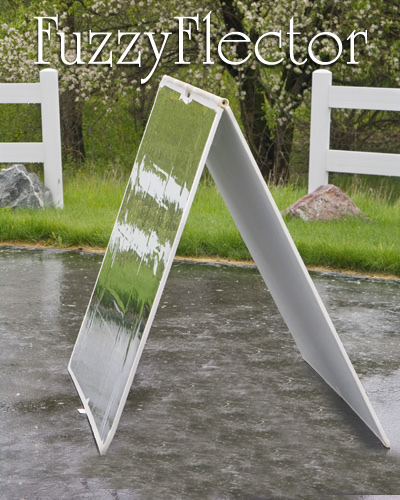 Just when you think you’ve got this book figured out, it reverses direction and runs down a new path. One of my favorites is the 54 page section that teaches us how to make our own equipment for both studio and outdoor lighting. Inspired, as I have been, by Dean Collin’s seminal work, Tinker Tubes, the Duenkels are famous for their low-cost, creative solutions to meet our equipment needs. They are probably best known for their FuzzyFlector, a self-supporting, sophisticated, multi-surfaced reflector system made from hardware store parts. The Duenkels not only give us step-by-step instructions on how to make it, they also give us a very careful explanation on how to use it. That’s important. There is nothing more frustrating than having a tool one cannot use. The Duenkels stuff will not end up in garages or closets.
If this were just a “how to” book, it would be well worth having. But, it is much more. In a series of philosophical essays, the Duenkels push us to wrap our arms around some of the issues that affect all photographers. Here are a few paragraphs from one of my favorites that deals with “self doubt” — those feelings that creep into our minds and tell us that we just aren’t very good at this stuff:
On a personal level, I’ve always been frustrated, unsettled, and confused. This discontent keeps me from growing satisfied with my work, which almost instantly leads to growing stale. At the beginning of a senior season, I’m always anxious to apply the things I’ve seen in magazines and other edgy sources to my senior photography, Then I get disappointed when all the seniors who come to us don’t look like the models in the magazines, or I didn’t get the opportunity to do what I envisioned in the off-season. By the end of the year, I’m angry with myself that another year went by when I didn’t ‘put it all together’.
Another reason it’s difficult to accomplish our goals is because the state of photography moves so quickly these days. One year something is hot, and the next year that technique is ‘so last year’. Sometimes its comical because over the years, photographers of “our era” have tried just about evry gimmick, pose, lighting tool, or photography style as each of us searched for our own personal identity. Because I started in the 1970’s, I’ve done most every thing that’s ‘new’ again, like flare, camera tilting, trash the dress, wallpaper backgrounds, chandeliers, studio lights in the background, hot lights, ring lights, belly pan reflectors, textures (negative sandwiches), cross-processed looks, and all manner of filters. Because I get bored easily, having done it once years ago is usually enough for me.
….
What’s the answer? Well, the only thing I can come up with is to keep pushing your comfort zones. If you’re comfortable, you’re not working hard enough. No one won a race by coasting all the way (unless you’re racing n a soapbox derby). Stay curent and in-touch with the best in the industry by attending conventions, seminars, and participating on internet forums.
And, read books.
(Copyright: PrairieFire Productions/Stephen J. Herzberg — 2009)
Related Posts
 Helping Each Other Out: Paying It Forward
 onOne Suite 5: Diverse and Powerful Plugins
 Survival Tips From Hanson Fong
 Performance Photography Pt. II
 Photography On The Web: R. C.’s Surefire Path to Successful Sites
One Responseto “Book Reviews: Stoppee, Odell and Deunkel”
Leave a Reply to Harvey V. Chua Cancel reply
foo




Thank you for the very useful articles. Do you have any articles on the business of photography?
Is there a feed (RSS?m Feedburner?) that I can sign up for so I will receive notification that you have new articles?
Thanks again,
Harvey V. Chua